Next cohort: April 2027
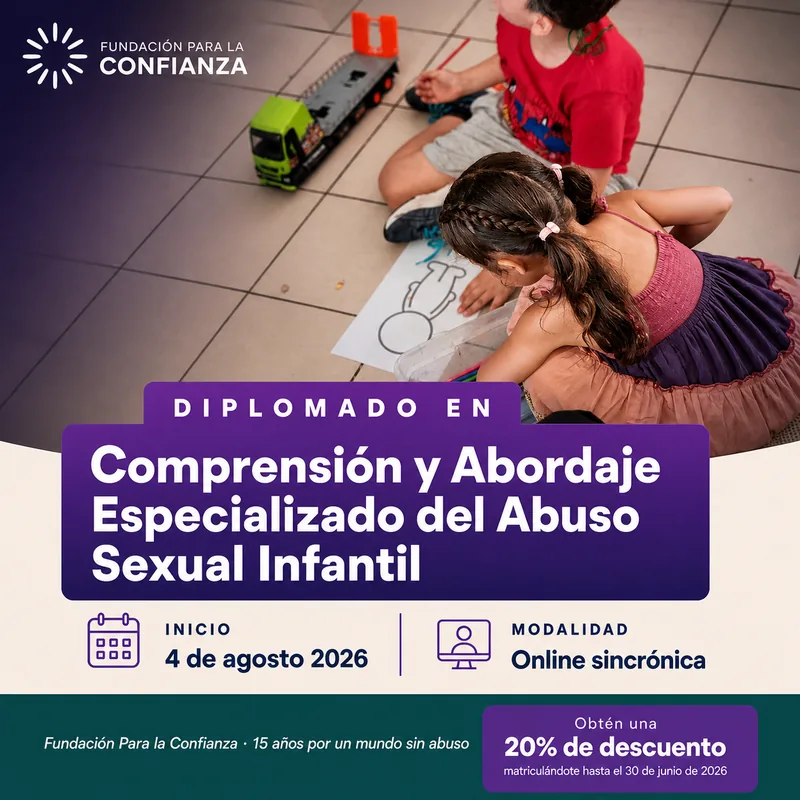
Diploma Programme · Understanding and Specialised Response to Child Sexual Abuse
Specialised training for professionals who work with children and adolescents, with evidence-based tools for their protection.
Download the programme (PDF in Spanish)
Course details
Academic workload 150 clock hours
Mode of study Online (synchronous)
Classes begin April 2027
Certification Fundación para la Confianza
Programme fee CLP 1,050,000
PRESENTATION
The diploma programme “Understanding and Specialised Response to Child Sexual Abuse” is a training proposal of Fundación Para la Confianza aimed at professionals who work in contexts of intervention, protection and prevention of sexual abuse in Latin America.
The programme brings together professionals from across the Latin American region, recognising the richness that the diversity of national contexts, legal frameworks and institutional realities brings to the learning process.
The diploma programme is organised into four modules in logical progression: history and approaches to understanding CSA, models of CSA with trauma-informed practice, children’s rights and public policy, and methods and techniques of specialised response. Each module combines a theoretical part and a practical part, so that what is learned can be transferred to everyday practice from the first session.
TRAINING ETHOS
This diploma programme starts from a conviction: those who work with children and adolescents in contexts of intervention, protection and prevention of sexual abuse come to that work with a history of their own, with emotions that contact with trauma stirs up and that rarely have a space in which to be named.
That is why the diploma programme includes a protected space where professionals can connect with their own experience and review from there the way they intervene.
Who it is for
- Professionals from Chile and Latin America who work, or seek to work, in contexts of intervention, protection and prevention of child sexual abuse.
- It is aimed specifically at professionals with a university degree in the social sciences (psychology, social work, sociology, education, political science, law), the health sciences (medicine, nursing, occupational therapy, physiotherapy) or other related disciplines.
- The diploma programme is open to professionals resident in Chile and to Spanish-speaking professionals in Latin America.
On completion
Competencies you will acquire
On completing the diploma programme, graduates will have developed the following capacities:
- Understand child sexual abuse from a comprehensive, historical and critical perspective.
- Apply the trauma-informed practice approach and lucid trust in their everyday professional practice.
- Know and interpret the legal frameworks in force in Chile and Latin America, linking them to their specific work.
- Implement detection, prevention and intervention strategies with children, adolescents and families.
- Sustain a careful, reflective and sustainable professional practice, integrating self-care and covisión (reflective peer supervision) as structural pillars.
Specialisation plan
Programme structure
MODULE I · 35 HRS History and Approaches to Understanding CSA
- Keynote lecture · Opening session
- U1 · Definition, Prevalence and History of CSA
- U2 · From the Power of Fear to the Power of Trust
- U3 · Systemic Relational Approach
MODULE II · 34 HRS Models of CSA with Trauma-Informed Practice
- U5 · Adverse Childhood Experiences (ACEs)
- U6 · Complex Developmental Trauma
- U7 · Life Course Model
MODULE III · 34 HRS Children’s Rights and Public Policy
- U8 · Universal and Inter-American Human Rights Systems
- U9 · Protection Systems and Regulations in Chile
- U10 · Public Policy on CSA
MODULE IV · 47 HRS Methods and Techniques of Specialised Response
- U11 · Detection and Prevention of CSA (comprehensive sexuality education, ESI)
- U12 · Intervention Strategies with Children and Adolescents
- U13 · Intervention Strategies with Families
- U14 · Reflective Covisión and Team Self-Care
How will you learn?
Synchronous sessions
The diploma programme is delivered online and synchronously through the Moodle platform. Classes take place live on Tuesdays and Thursdays from 19:00 to 21:00 Chile time, for a total of 38 live group sessions over four months.
Each unit combines theoretical content with practical activities applied to each participant’s professional context, ensuring that learning is anchored in concrete practice from the first session.
Admission requirements
- Certificate of a professional degree or bachelor’s degree in the social sciences, law, health or education.
- Certificate from the Register of Persons Disqualified from Working with Children and Adolescents (Registro de Inhabilidades), or its equivalent in the country of residence.
- Letter of intent stating motivation, expectations and future professional plans.
Frequently asked questions
Does the diploma programme provide official certification?
Yes. On completing and passing the programme, you will receive an official certificate issued by Fundación para la Confianza, which attests to your training in the understanding and specialised approach to child sexual abuse.
What happens if I miss a live session?
All classes are recorded and remain available for one week, in case you are unable to attend a session.
Translation by Fundación Para la Confianza. In case of any difference, the Spanish version prevails. Spanish version.