Chapter 5 · 10 Years for a World without Abuse
To trust is to transform society
Chapter 5. Two women tell of their cases in the face of the statute of limitations; José Andrés Murillo reviews the Foundation’s advocacy on children’s rights legislation, and the Observatorio para la Confianza (the Foundation’s Observatory for Trust) explains its work with children and adolescents in State care.
The struggle against abuse must —necessarily— take place not only in the everyday spaces we inhabit, but also in our laws and our justice system. The great fight against abuse cannot be seen without taking into account the legislation in force today, and understanding that it holds an enormous opportunity to change the conditions under which situations of abuse are defined, punished and prevented.
In this chapter we present two testimonies that focus on the absence of a statute of limitations, its relevance in cases of abuse, and the resilience of those who decide to pursue their cases even though they are time-barred. We also share how, over the years, the Foundation has been able to influence different bills, and how its commitment to this task has led its team to start new projects, such as the Observatorio para la Confianza (the Foundation’s Observatory for Trust), which seek to influence the legal approach to abuse.
No statute of limitations
Elisa
The afternoon of Thursday 16 June 2016 is one that Elisa García-Huidobro remembers with emotion. That day was the first time she met four other women who, sadly, shared something in common: all of them had been victims of abuse by the same perpetrator.
What also made that afternoon very special was that, just before they went into the place where they met, the man who had caused them to come together announced his resignation from the post he held: Chile’s ambassador to France. The emotion ran high, and mixed with it was a strange sense of how cathartic it was to meet, for the first time, other people who had lived through something so painfully similar.
What also made that day special was that the meeting took place in a small office in Las Condes, where Fundación para la Confianza was based at the time.
“We saw each other’s faces for the first time, all of us together, and each one told her own story. It was like a GAMU [a mutual support group], but the common factor was the perpetrator. How atrocious, it was atrocious, but it was beautiful, it was very moving”, Elisa recalls.
One of the most moving things, without a doubt, was hearing the news of the resignation, because it marked the beginning of a process. “I mean, we were jumping for joy. Obviously they had made him resign, and it was the first consequence of having exposed what happened to us. And from then on we gave this man no respite, because from that very first time we met, a strategy started to take shape so we could work out carefully what we would do”.
That is how a process began which, although they were not very convinced about pursuing it, turned out to be very necessary. “Very soon after that day, we met with Juan Pablo Hermosilla and José (Murillo), and Juan Pablo’s rallying speech urging us to report was incredible. He is so inspiring. I mean, after everything he told us, I told him I was going to name my son Juan Pablo”, she recalls, laughing. “He pushed us, he emboldened us, and it was like, ‘right, let’s go for it, you can do it, you’re strong, you’re protected by us, nothing is going to happen to you’, and that’s when we started to draw up this communications strategy to make the case known, and for justice to be done”.
Until that moment, though, filing a lawsuit was something they had not even imagined. They did not think it was possible.
“Just imagine, this person used to tell the domestic workers he abused: “go on, sue me, who’s going to believe you”. I mean, the asymmetry there was with young women who had no access at all to a lawyer, to all those kinds of resources, even to imagine they could do something against this man, it was unthinkable, impossible”.
That is why Juan Pablo’s rallying speech was not only an encouragement to sue, but also a way of realising that —always— doing something to obtain justice is possible, and necessary.
However, when the first possibility of doing something came into view, another stumbling block appeared. Elisa was ten years old when she suffered the abuse, so at that time, being 32, her case had become time-barred under Chilean law. The statute of limitations is one of the ways in which a person’s criminal liability is extinguished, that is, the power the State has to punish with a penalty the offence or offences that person has committed. This extinction of liability occurs through the passage of time between when the act took place and the moment it is prosecuted. But although the statute of limitations prevents the State from bringing a person to trial for an act, it does not prevent the act from being investigated by the Public Prosecutor’s Office or by the former criminal court (Juzgado del Crimen), depending on when the abuse took place.
Statute of limitations
The way in which a person’s criminal liability is extinguished through the passage of time between when the act took place and the moment it is prosecuted. It prevents the State from bringing a person to trial, but it does not prevent the act from being investigated.
This last point gives the victim the opportunity for the State to take care to find out, to the best of its abilities, what happened and who may have taken part in the offence or offences.
So, although obtaining a penalty was not an option, being able to show that the abuse did happen was. Reaching this point, however, was a much longer road than the one described here so far.
Elisa, as she says, is very much one for going to therapy. Her sister, who is very close to her, is a psychologist and always explained to her how important it was. Years before the meeting at the Foundation, in one of her therapy sessions, she remembered something she had experienced with her stepfather. When the session ended she told her sister, and for the first time she put a name to what she had lived through. “Only then did I start working on this abuse that I had no idea was abuse. I mean, until that moment I didn’t consider myself a survivor and it took me a long while to accept that I had been a victim of abuse, and I worked on it very intensely for years”.
In the end it was her sister who, some time after realising what had happened, helped her get in touch with the Foundation.
“So, when we found out the case was time-barred, I wasn’t really there, I didn’t give it much importance actually, because if anything I just wanted to keep seeing my psychologist and get over it”, until something “clicked”, as she explains.
When they met with Juan Pablo, the idea came up of telling the case in the media, in a major outlet that would make an impact. The story, however, had to be told by all of them, including Elisa, “and that’s when I said, damn, I don’t know if I’m ready to tell the whole of Chile that I was a victim of child abuse”.
“I felt not ready at all, and we met with Juan Pablo again and he said to me:
Look, basically you have to decide whether you go ahead or not, and imagine when one day you tell your sons and daughters everything you went through and they ask you: “Mum, and what did you do?”.
That was a dagger to the heart, and I thought: shit, I mean, what am I going to answer them, that I kept quiet? That was the turning point for saying right, OK, that’s it, I have to do it”.
It was not an easy decision, but she realised that “I had all the tools, I was in a position of privilege in terms of all the networks I have. I had therapy supporting me, I had my sister, and these other women, the best lawyer in Chile, Fundación para la Confianza, so I was stuck, I couldn’t say no, it was my turn”.
The strategy they began to plan had to be meticulous and intelligent. They wanted to tell their story, and that of all the women who met that Thursday at the Foundation, and they had to do it well.
They decided to go with an outlet that would “hit him hard”, as Elisa puts it, the man who abused her, and that outlet ended up being Revista Sábado, the Saturday magazine of El Mercurio, because they felt that it would also have the necessary respect to handle the story as it deserved.
“This is a powerful guy, so even with the feature ready, it took a long time to be published. It was a battle they had to fight at the paper until exactly what happened with Harvey Weinstein in the US, the Me Too Movement started, and a worldwide movement began. That’s when the editor of El Mercurio at the time said ‘right, we’ve got this huge case, we’ve got it stored away, let’s run it’, and she took the risk and published it”. From that point on, a new road began.
“You can’t imagine the nerves the night before it came out. My sister was jumping on the kids’ trampoline from nerves. Imagine you’re about to go out nationwide with your story of abuse. Besides, I hadn’t read the feature, I’d only seen the photo they took of me”, Elisa recalls.
And finally, the feature was published.
“The support was huge, pretty much unanimous, and I remember that for a week this case was on the morning TV shows. We made a very good decision, together with Juan Pablo and José, and they told us “look, no more talking, you’ve already spoken and the die was cast, the lawsuit had already been filed. The feature had already been published, and it was crazy, it was super intense, but it was great, for me as a victim, to feel the support of so many women and of people I didn’t know, getting messages on Facebook saying: “Elisa, how brave”, and I didn’t know what to do with that “how brave”, I had just done it, and knowing there were so many people who had been abused was very striking”.
“Realising that there are so many, thousands of people who have lived through the same thing as you, was very shocking, but it was also very comforting to know that I had helped, that the feature had encouraged people to bring their own cases of abuse into the open. That was great, it was like: “that’s it, I helped one person, I’m paid in full”.
By the time the feature was ready, the lawsuit had been filed, and the feature, for Elisa, obviously helped make this an “emblematic” case, and that also puts pressure on the judges, because there is social pressure. However, the case was long, and after the first instance, where it was put on record that the events had indeed happened, the case was closed. They did not formally charge the perpetrator, but nobody said the abuse had not happened.
As Elisa tells it, “they appealed this ruling. He has a lawyer who was the one in the Larraín case, and who was known for not being very above-board, so the Court of Appeals magically said that none of this had happened. This is obviously very simplified, they are much more elaborate interpretations. When all this happened, which was a low blow, my mum wrote a letter to El Mercurio defending her husband, and that was another very low blow. After that we didn’t want to do anything more. We had basically already done all the work of showing publicly what had happened, and I have the feeling that public opinion believes us victims, and I’m quite content with that. I feel I’ve already fought the fight, and people already know who Patricio Hales is”.
Today, as she explains, she feels safe, and much better prepared: “it helped me a lot to overcome millions of fears. I feel I can defend myself much better, I have a million more tools because I overcame the fear that this man could hurt me. Today I can set limits, because I no longer want anyone to cross my limits. I feel like Rambo”, she says, laughing.
“For me it was a battle well and truly won. Today I’m a much happier person after having done this, braver, bigger. It was really hard, but it was brilliant, it was killing the real monster. Whatever did or didn’t happen to this guy, I don’t care about him, I care more about how the other victims came out of it, how I came out of it, and I came out much more empowered, with less fear, with less shame”.
She also acknowledges that “the Foundation’s support was tremendous. I can’t imagine how it could have happened without their empowerment, accompaniment and constant support. Yes, we became like a family”.
And of course, “I completely and wholeheartedly recommend that people do it. I have a saying that I really like, which is “the truth heals”, and boy is it true. It’s a phrase that captures a lot of what I lived through at that time, and still now”.
“It makes me so happy to tell it, and I don’t talk about it often any more, because I’ve been leaving the subject behind; it was too intense. I devoted six years of my life to this, and now it was lovely to move past that stage, to do my own things, to live my life. I needed to see other things, but it makes me happy to tell it. It’s a success story (laughs), how cool”.
Estefanía
Months had gone by since Estefanía Milla-Moreno had last come back to Chile. For ten years she has lived in Vancouver, Canada, working and doing postgraduate studies, so she came back to the country occasionally, to see her mother or to deal with paperwork.
On one of those trips, something very particular happened.
Manuel Montt street, in Santiago, has great emotional value for Estefanía. First, because her mother lives there, and every time she comes back to the city she takes the same bus to see her and travels along much of that long street. Also, because on Manuel Montt is the clinic where Estefanía was born, and where she gave birth to her first daughter. But also because between those two places stands the school she attended as a child, where a teacher sexually abused her on repeated occasions.
On this particular trip, something happened to her, and she decided to get off the bus a couple of stops early, walk into her school, and report.
“I closed myself off from this story for a long time, but I think that, as a woman, but above all as a mum, there have been certain milestones that have made me face what happened to me, for about 10 years now, particularly thanks to several therapy sessions, the support of my husband and my mum, and other micro-abuses I experience for being a woman. I like running, even though I feel that when I do it I take the risk of exposing myself to a rapist. I go walking, dancing, measuring plants in a place where there are few people, and I feel the same. Always at risk and therefore always on alert”.
There was one particular event that made her realise she had to do something. “The first time my daughter’s school assigned her a male teacher, I fell apart and felt a very great anguish. It was the first time I considered the option of sharing my story and asking for support, because at that moment my daughter was the same age I was when the abuse against me began. I did it convinced that my secret was more harmful than useful”.
“That’s when I changed. For a long time I convinced myself that what happened was terrible, but it was already part of the past, until I was afraid the same thing might happen to my daughter. The other times I felt that wish to do something, to report, I couldn’t, until the bus happened to stop right there at the school, and I got off. I feel it was something that kept forming, growing, building up, until it overwhelmed me. I still wasn’t completely sure what I was going to say, I just followed the impulse that was leading me to empower myself in that space where my rights had been violated so many times. I stopped at the door, full of fear, shaking. It was break time and I caught sight of a pupil about the age I was when I went to that school, and I took it as a sign.”
In the end she was able to speak with the head teacher and tell her what had happened to her. Not much progress was made, admittedly, but something happened that she is grateful for to this day: at that meeting, one of the people present knew the Foundation and told her a little about it. She was interested, and got in touch.
“My idea was to find out what they could do for my case. I understood that my only feasible route was a public denunciation and maybe convincing the people who ran the school to install boxes in some parts of the building so that pupils could flag abuse anonymously. My expectations of legal justice were low, and I had to try more than one format. When I heard about the Foundation, it made me curious and hopeful.
She did not have a plan worked out, but she did have a motivation: “up to that moment my mission was to tell in detail what they did to me, to make sure that teacher did not go on teaching and that they did not rule out that child sexual abuse could go on happening in classrooms”.
The road to doing something, however, had begun much earlier for Estefanía.
“For some time I have been studying native Chilean plants that are able to mobilise heavy metals in a tailings deposit (the waste left by mining). Research has shown that certain plants can, through mechanisms of sequestration, immobilisation and/or alteration of the medium, change the mobility of those metals towards and within the plants. This allows the leaves and roots to filter metals that can later be extracted. This knowledge can be used to restore ecosystems at mining production sites”.
As she explains, her research requires her to spend a lot of time alone, monitoring the plants, very focused, and therefore with a lot of time to think. And in that waiting, she reflected on her story and on that of plants that live in highly toxic environments. “Understanding the resilience of plants has helped me trust in my ability to give new meaning to the abuse I lived through”, she explains.
And that was the moment she decided to write down what happened to her, in an exercise that was painful but very liberating. When she managed to finish it, and after having gone to her school, she sent it to the Foundation for them to read and comment on, and that is where the relationship began.
The welcome was immediate, and she found that, for the first time, she was beginning to speak a similar language, without needing further explanations. “In Vancouver I did therapy in English, and I found that, if talking about these things is already really hard, not doing it in your mother tongue is even more challenging. When I spoke with José Andrés Murillo I felt it wasn’t necessary to re-traumatise myself by giving details, that the core thing was to support me”.
“Within that relationship we started to plan the possibility of publishing the piece, and José came up with the idea that it would be better to bring it out through CIPER, a Chilean digital investigative journalism outlet. José was really proactive, he put me in touch with Mónica González, the outlet’s director at the time, and we had a conversation of about an hour. I send it, she edits it and it gets published. I never expected sharing my story would have so much impact”.
One of the things they told Estefanía at the Foundation was that it was important for her to be in therapy, because, given previous experiences —which the Foundation and its founders had dealt with— it would be a hard process “and because even though my psychologist told me I was almost ready to be discharged, what came afterwards was not so much hard as surprising”. The response to the piece was immediate and massive.
“My reparation began, and an end to my eternal and painful silence”.
As she tells it, Estefanía is actively connected with Chileans who arrive in Canada, and with the Latin American community in Vancouver: “in my faculty, I take part in salsa groups, sports, and so I’m lucky enough to know a lot of people. I had set out to keep my story away from the people around me. This was one of the things I thought about deeply before publishing my story, because I had to think hard about whether I could and wanted to give up being associated with my joy and strength and have people start defining me by my experience as a victim of child sexual abuse”.
“And in the end what happened was that a lot of people who found out needed me to clear up their doubts about it, to explain how (perhaps the hardest thing to answer), when and for how long I was abused. It was a very strange thing, because many people, although well-intentioned, did not react like: “oh how awful, how can I help you?”, but needed more information or reacted with disbelief (e.g., Did he really rape you?). Many of those people were even from my close circle. In this process, the support and accompaniment of the Foundation were fundamental.
This whole revelation led her to understand that, unfortunately, we people do not know how to support or help someone who has been abused. That there is a lot to deconstruct and learn.
After that episode, José put Estefanía in touch with Arturo Greene and Juan Pablo Hermosilla (the Foundation’s lawyers) and they decided to file a criminal complaint (querella) that would give access to a serious investigative process. “although I had already made a report when I went to Chile, on the same date I visited the school, it had not managed to move forward and had been closed. For accessing the courts, the Foundation’s support was and still is tremendous”.
However, before long, she learned that her criminal complaint, since it described events that had happened in her childhood, had been closed again because of a possible statute of limitations, which became a great obstacle, but not a stop, because the road to her “detoxification” had already begun, and she was not going to turn back. So, together with her lawyers, Estefanía went to the Court, which, recognising the obligation of the State of Chile to give her access to justice through a judicial process, ordered an investigation to be opened.
“I felt I had to do something on my own terms, breaking with the silence, the secrecy, the deep shame and a certain sense of responsibility that weighed on me. It was a painful process, because when I wanted to communicate it, my throat would tighten until no words came out. The piece I published with Mónica’s help served me to avoid those sensations, but also to say to that other adolescent, woman, older woman who is on the other side of that piece: I see you, it is not your fault, this is sadly common, it has to stop”.
What Estefanía wanted to achieve, with the piece and then with the criminal complaint, was to speak about it without guilt, in her feminist voice, as a woman, mother and granddaughter: it was a “no more”. “Even so, writing my account was difficult. They are memories of many emotions, deep-seated pain, anger and sorrow feeding each other. You write a sentence and cry for a day, and vomit and sleep the next. Once it was finished, coming back to the text or hearing what certain people thought of it was also painful”.
In the case brought by the Foundation, the teacher was called to testify, but then the pandemic began and the proceedings started to run into difficulties in moving forward, although they remain open.
“They called my classmates from back then to testify. In fact, my lifelong best friend is in that group. The terrible thing is that even if there are other people abused by this teacher in the years when I suffered his abuse, if they reported close to my date, it could also be declared time-barred. The law falls short. It does not honour the time it takes to come to terms with reality. My pain, anger and desire for justice do not expire. And if you don’t deal with those feelings, the outcome can be fatal. When they don’t believe you, when there is no support and no conviction, people who were already vulnerable because of age, power, class, ethnicity or education are put at far too much risk”, Estefanía explains.
“My hope, and what I wish for, is that the removal of the statute of limitations be fully retroactive, so that people like him are in prison”.
As she says, for her it is really valuable to break the silence, because only that way can abuse be stopped. Drawing on her experience she has done several things in the university faculty where she works. She trained and has given seminars on how to prevent sexual harassment in the Faculty, “because sexual harassment will keep happening, particularly where there are power dynamics, which are very present in academic settings”, she explains.
“And in that long process of change, the Foundation was and still is a light in the darkness.
I felt backed from dawn to dusk, with a great deal of professional and personal support. My consent has been at the centre of every process the Foundation carries out on my behalf. And that gives new meaning to the way I relate to the people around me, and in turn to my autonomy, self-esteem and empowerment.”
She tries to explain, though, that she does not feel entitled to recommend that anyone report, “because the path of survivors is so particular and specific that it will be different for each person. What I do recommend is not to carry this weight alone. I also recommend trying different formats for breaking the silence: speaking, writing, using artistic expression, among so many other options. When I began to share my story, to relive it psychologically and physically, I had fewer nightmares and flashbacks. In these processes emotional and physiological things certainly happen, so lean on the Foundation, or on whoever you want and trust, because we really must reclaim our freedom, safety, empowerment and consent. In this process, I gave new meaning to my existence.”.
Policy advocacy of Fundación para la Confianza
By José Andrés Murillo, Executive Director, Fundación para la Confianza
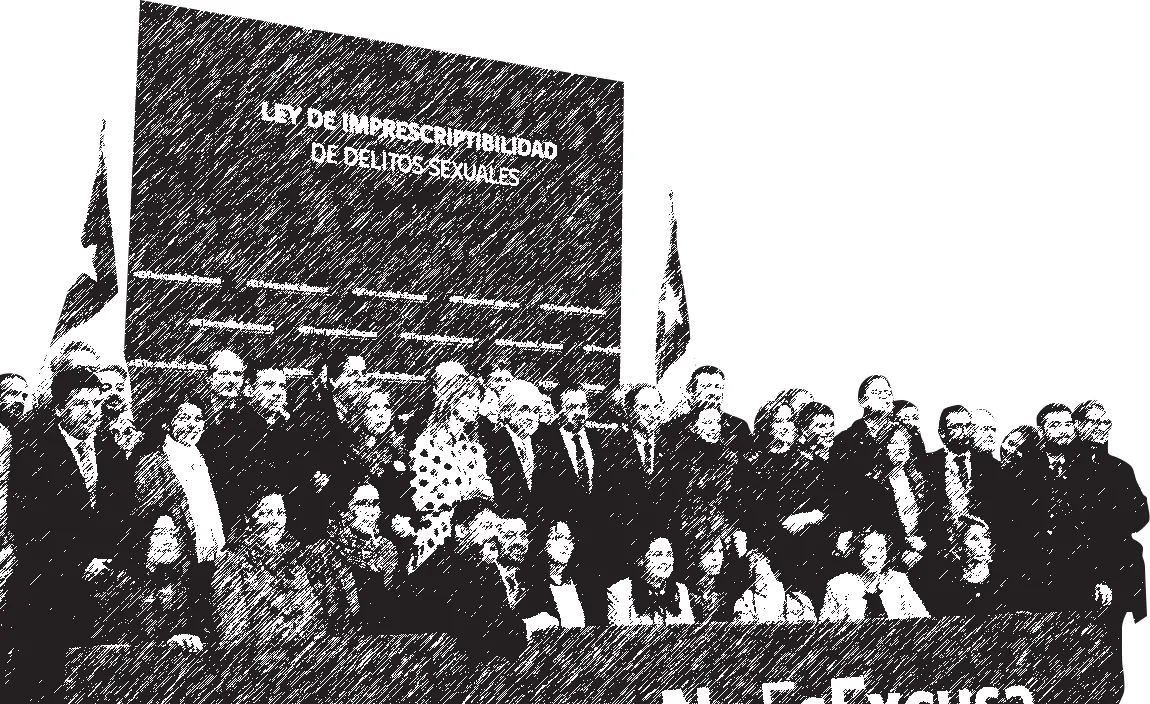
In 2011, before it was a year old, Fundación para la Confianza was invited to the National Congress to speak about a bill that at the time was considered totally disruptive. This bill, driven above all by the then senator Patricio Walker, sought to remove the statute of limitations for sexual abuse committed against children and adolescents. At first the proposal went against the prevailing culture. The dogma of the statute of limitations seemed untouchable; however, activists, academics and survivors kept joining, and, in the face of what seemed utopian in 2011, the bill was passed unanimously by Congress in 2019. It was a real and profound cultural change.
- 1990Chile ratifies the Convention on the Rights of the Child
- 2011The Foundation is invited to Congress to speak about the bill that removes the statute of limitations for sexual abuse against children and adolescents
- 2019The bill is passed unanimously in Congress
As part of that change, we joined, as a Foundation, other initiatives, people and organisations that were fighting for Chile to have a system for the protection of children and adolescents in line with the Convention on the Rights of the Child, which Chile had already ratified in 1990. A system for the protection and promotion of rights needed a law that would effectively guarantee what the Convention establishes. That law does not yet exist in our country. Various excuses have left every bill forgotten. We hope the current proposal will be passed soon.
In addition, for years we needed an autonomous ombudsperson’s office for children and adolescents, a body that now exists, largely thanks to pressure from civil society and the commitment of some members of Congress. Chile needs a lead body on children and adolescents to coordinate the different public policies that concern them. Today we have only an undersecretariat with few powers and a profile that is more political than technical. What we seek is a body with ministerial or supra-ministerial powers, able to take forward the challenge of prevention and the coordinated implementation of policies for children and adolescents.
What the Foundation has championed together with other organisations
- Removing the statute of limitations for sexual abuse against children and adolescents, passed in 2019
- A law guaranteeing what the Convention on the Rights of the Child establishes, which did not yet exist when the book was written
- An autonomous ombudsperson’s office for children and adolescents, which now exists
- A lead body on children and adolescents, with ministerial or supra-ministerial powers
I remember well when we talked with the educator and children’s rights activist Francesco Tonucci and with the Chilean psychologist and academic Fabián Nichel, who at the time headed Fundación para la Confianza, about the need for the adult world to listen to children. And it was not only for their sake, but for ours. Our adult voices are generally flawed, blinded by the adultcentrism in which we grew up and in which we move. Childhood, by contrast, is a new voice, a new way of looking at the world that creates a new world. One we had not imagined. Every time humanity reaches a dead end, it is children who invent a new way of seeing and illuminating, and that new light shows the way out; it is the way out. A system that promotes and guarantees the rights of children and adolescents is not only a social policy but a structural one. All of us depend on it.
It is by putting the focus on children that we will come out of the social, political, economic and, above all, mental health crisis we find ourselves in as a country. And we will keep fighting for that as an organisation. The words Gabriela Mistral wrote in 1927, amid social weariness and unrest like that which our country has lived through, once again, since 2019, are fully relevant today:
“It is possible that in the social conflict we are living through, which it is useless to deny, the question of childhood may be the only one capable of uniting adversaries in accepting reforms on a grand scale. I often think that it is with this matter, and with no other, that “the new organisation of the world” could begin, because even the worst raise their heads, listen, become for a moment noble and welcoming, when the child is named. The most belated modesty rises to the face when any individual without social conscience is told about the misery of children […]”.
Observatorio para la Confianza
By Sofía Aliaga, Coordinator of the Observatory, Fundación para la Confianza, and Benjamín Gálvez
“The truth is, things still aren’t changing”
With that sentence, Edison Gallardo, aged 42, explains why his fight to stop the violation of the rights of children and adolescents in Chile goes on, and why his main motivation has been to stop what he lived through in his childhood, which is still being repeated today.
From the age of two until he was fifteen, Edison lived in a residential care home of the Servicio Nacional de Menores (SENAME), Chile’s national child protection service, and rather than an experience that defines him, it was a history that has led him —today— to find the courage to speak up for those whose rights are still being violated in the same way his were in his childhood.
In 2017 his experience became publicly known with the launch of his book “Mi infierno en el SENAME” (My Hell in SENAME), in which, as well as recounting the abuse he suffered, he made a powerful critique of the current system for protecting children’s rights in Chile. Since then, everything has snowballed: “at first I only wanted to publish my book, launch it and be just another writer, and people started to attribute to me a commitment that I hadn’t taken on up to that point. I wanted to get on with my life, and I’d say to myself “right, this is the last march I take part in”, and then another one comes, and another, and there have been so many last times that you realise you’ve spent five years in your last times. Then they started inviting me to sessions of Congress, and I went to so many sessions that I no longer knew which would be the last. You don’t realise when you decided to start, and suddenly this is already a need, you can’t get out, you can’t pretend it has nothing to do with you any more”, Edison recalls.
“People identify you with a cause, and that gives you more courage to keep going, because you know that whether someone attacks you or not, you’re never alone”, he adds.
When he was about to launch his book, he had his first contact with the Foundation. He got in touch with James Hamilton so that he could present it, “and from there we forged a really important relationship. We met a couple of times, we talked about how hard it is to be someone who reports, he shared several tips with me for keeping my strength up”.
In addition, “I had offered myself as a witness in the sexual abuse cases against the priest Francisco José Cox, of whom I was a victim, and in which there were two other people who had reported, and I got so involved that I decided not to stay out of this important milestone, so that’s when I became part of the report against Cox”, Edison recalls. This marked the start not only of a relationship of support from the Foundation, but rather of a collaborative bond, as he explains: “I’ve also given seminars and talks on child sexual abuse with the Foundation; when there’s a need to talk about violations of rights, they count on me, so above all I feel we’ve helped each other spread the same message”.
Within the Foundation, it began to become clear that spreading the message was one step, but that it was necessary to go beyond showing a reality. Change had to be brought about not only in society, but in politics, in the laws, in politicians’ attitude towards children’s rights, and in the protective role the State ought to have.
With that idea in mind, in 2018 Fundación para la Confianza created the Observatorio para la Confianza which, since that year and thanks to an alliance with Fundación Colunga, monitors and follows up on the situation of the rights of children and adolescents in State care.
In Chile, the government body responsible for protecting children whose rights have been violated, in family or personal circumstances, is the Servicio Nacional de Menores (SENAME). But this institution has been heavily questioned after a series of circumstances came to light showing that the State does not have the real capacity to protect the rights of the children cared for within this institution’s network. These irregularities, together with the deep pain and indignation such situations cause, prompted the creation of the Observatorio para la Confianza, a body that seeks to have a decisive impact on creating conditions in which every child and adolescent in State care has all their rights respected and protected.
For two years, the Observatory has devoted itself to research and to systematising information on children in State care, publishing, up to September 2020, seven technical reports, eleven technical notes and two annual reports that show the state of the rights of children living in residential care homes in the SENAME network. It has also made information about children and adolescents in State care transparent and accessible, and has in turn influenced the formulation of rights-based public policies, so as to consolidate the State as the main guarantor of children’s rights.
- 7technical reports
- 11technical notes
- 2annual reports on the rights of children in residential care homes of the SENAME network
- 93government measures for children, followed on the Vigilantes por la Infancia platform
But advocacy is never a simple task for a civil society organisation, still less for an Observatory that built its strategy on the constant pursuit of profound change while, at the same time, trying to contribute in practice through producing information and technical work. How can one have influence in a society where lobbying is so unequal? One answer we found was to join forces with other organisations that had the same goal.
Working together became the core of our advocacy. The Comunidad de Organizaciones Solidarias (COS), Grupo Miradas, Fundación Infancia and Fundación San Carlos were the first to join in pursuing that goal. With these organisations we worked on a proposal for the bill creating the Specialised Protection Service for Children and Adolescents, an initiative that had a good result: several of the recommendations were systematised and included by the committee. In this way, unified work to draw up concrete proposals bore fruit.
Working together has made it possible to reduce the asymmetry in advocacy on children’s issues, where various corporations, accredited bodies or related actors are much better positioned than civil society, which does not have that capacity. In this respect, the Observatory’s position is that these actors may exert influence, but they cannot be the only ones.
“I felt envious the first time I heard about the Observatory, because I’d been planning to do exactly that”, Edison recalls, laughing, and adds: “I thought they’d beaten me to it, but after I met the team of professionals, I acknowledge it’s a body that is taking care, but many more are needed. It is doing, out of dignity and care, what the government should be doing out of obligation”.
The Observatory, however, has not only sought to influence the bill for the new service that will replace the current SENAME. Chile is the only country in Latin America and the Caribbean that still does not have a law on Guarantees and Comprehensive Protection of the Rights of Children and Adolescents. Along these lines, the Observatory holds that our country urgently needs to move towards a system for the comprehensive protection of children’s rights, in which the State respects, protects and fulfils its responsibilities and develops comprehensive public policies with coordinated actions to promote, prevent and protect their rights.
To follow up on the passage of the Guarantees bill and on the other 93 measures for children promised by the current government of Sebastián Piñera, together with Fundación Ciudadanía Inteligente, the COS and Fundación Colunga, the Observatory has taken part in “Vigilantes por la Infancia” (Watchdogs for Children), a platform that allows citizens to exercise social oversight over decision-makers on children’s issues, and that measures the level of fulfilment of the different proposals made by the current Government. The work done through this platform is a source for various members of Congress, who in several debates use as arguments the analyses and reports produced by this group of organisations.
However, as Edison asserts from his experience in Congress, “every politician, every deputy in this country is a stumbling block, except for a few, because they listen, they’re moved, but that’s where it all stops. So you have those who listen to the people whose rights have been violated constantly, but there are several others who prefer to listen to the Harvard scholar, with a master’s in public policy, who has empathy with the profession but doesn’t have the experience, rather than listen to experience itself”.
He continues, adding: “in fact, sometimes I think that the empathy they show when it’s our turn to speak is fake, because they keep acting the same way. It’s a matter of being politically correct, but not committed, which in the end takes shape as a party-political commitment with an adultcentric way of thinking instead of having a social conscience”.
This year, 2020, the agreement with Fundación Colunga, which has funded much of the advocacy and research work carried out by the Observatory, comes to an end. The challenge, therefore, is to make this great project self-sustaining, so as to keep contributing and achieving concrete progress in the State’s respect for, protection and fulfilment of human rights.
And in that vein, Edison’s dream for the future is clear: “I hope child sexual abuse is reduced to zero. Reducing violations to zero is impossible, but it is necessary to increase the penalties for sexual offenders, it is necessary for the child to be considered a rights holder, with guarantees like the ones the current government is denying, and by denying them it is producing the poor and the uneducated of the future.
Profound changes are needed, because what do you gain by knowing that there are violations of the rights of children and adolescents? We need a change of consciousness, we need to value the child as they deserve, as the future of Chile, even if it sounds like a cliché”.
About this edition. Web version of the book 10 Years for a World without Abuse (10 años por un mundo sin abuso), published in Spanish as a PDF by the Fundación para la Confianza in 2021 (first printed edition of 500 copies, Ograma Impresores; ISBN 978-956-402-822-4). Director: José Andrés Murillo. General coordination: Nicole Del Río. Research and writing: Benjamín Gálvez. Art direction and design: Cristhian Sotomayor. Illustrations: Jesu Villa and Cristhian Sotomayor. Editing: Natalie Sève. In this version, errata have been corrected and graphics summarising the content have been added; the illustrations of the people who give testimony are not reproduced. Figures, positions and legal references are as of the date of the book. Download the original PDF (in Spanish)
Translation by Fundación Para la Confianza. In case of any difference, the Spanish version prevails. Spanish version.